Leadership effectiveness - The feedback series, Part4.
In the final article of the feedback series, we go deeper...literally. Building on feed up, feedback and feed forward, Part 4 explores the four levels of feedback depth identified by Hattie and Timperley: self, task, process and self-regulation. Most leaders give feedback at the surface. This article shows you what high-information feedback looks like, why praise alone can actually decrease performance and how a coach-like shift from statements to questions unlocks the most powerful level of all. If you want feedback that builds capability, not just compliance, this is where the framework becomes truly transformational.
NEUROSCIENCELEADERSHIPEFFECTIVENESSHIGH PERFORMING TEAMSFEEDBACKDEEPTH
Roland Lewis
4/30/20267 min read
Leadership effectiveness - The feedback series
Part 4: Deepening feedback practice
Across this leadership effectiveness series, we have explored a practical framework for structuring your journey through feedback. The structure is sound, however, what it doesn’t have yet is depth.
In my experience, the gap between leaders who give feedback and leaders whose feedback genuinely transforms performance isn’t about frequency or intent. It’s about depth.
So, consider this;
How much useful information does your feedback actually contain?
Over the first three articles in this series, we’ve explored the three types of feedback that Professors John Hattie and Helen Timperley identified in their 2007 paper, The Power of Feedback — feed up (where are we going?), feedback (how are we going?) and feed forward (where to next?). If you haven’t read those yet, I’d encourage you to start there, because this article builds directly on everything we’ve already covered.
Today, we go deeper — literally. We’re exploring the four levels at which each of those three feedback types can operate and how combining them strategically is where the real performance improvement happens.
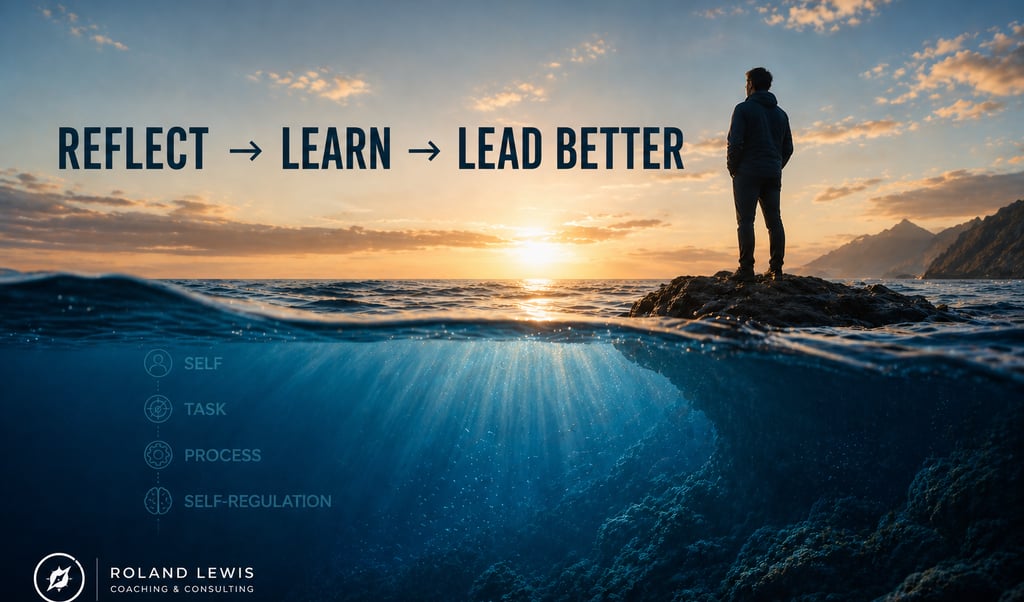
The four levels of feedback depth
Hattie and Timperley’s research identified four distinct levels of feedback, each operating at a different depth of the learning and performance process. They sit on a spectrum — from lower-information to higher-information — and the level you operate at has an enormous bearing on the impact your feedback delivers.
Let’s walk through them.
Level 1: Self feedback
This is feedback directed at the person themselves. It’s most commonly experienced as praise or personal affirmation.
“You’re a natural at this.” “Great work.” “You’re brilliant.”
It feels good to give and it feels good to receive but, here’s the kicker, used in isolation, the research indicates it actually decreases performance.
Why? Because it tells the person nothing useful about what they did, how they did it or what to do next. It redirects their attention away from the task and toward the self, making this an identity conversation. When the next challenge comes and doesn’t go so well, that person has no improved strategy to draw on, just a label that no longer fits. They just aren’t good enough.
Self feedback does have a role. A brief, genuine acknowledgement of effort or character builds trust and psychological safety — the conditions that make higher level feedback land. It just cannot carry the weight of development on its own.
Level 2: Task feedback
Task feedback is the most familiar form. It responds to the correctness or quality of a specific piece of work.
“Check step 3.” “That’s the right answer.” “The data point doesn’t quite connect back to your conclusion.”
Task feedback is more useful than self feedback because it gives people concrete information about where they stand and it does answer the “how am I going?” question in relation to something specific. The research suggests it is most powerful when there is a meaningful balance between positive and corrective information.
The limitation of task feedback is that it answers a question without building capacity. You know you got step 3 wrong but do you know why? Do you know what thinking led you there or what strategy would have prevented it? Not yet. More information is needed.
Level 3: Process feedback
This is where feedback starts to do its best work.
Process feedback shifts attention from what happened to how it happened. It connects the outcome of a task to the thinking, strategies and approaches that produced it.
“Your argument is compelling because you grounded it in evidence before making the claim - that’s the strategy at work.” “Try grouping your evidence by theme rather than by source, you’ll find the structure holds together better.” “The method you used works here, but in more complex situations a different approach will serve you better. Let’s talk about why.”
Process feedback builds knowledge and strategy. The person leaves with something transferable - a lens they can apply going forward. This is why it consistently outperforms task level feedback in the research. Growth isn’t about knowing the outcome. It’s about understanding the mechanics that produced it.
Level 4: Self-regulation feedback
This is the deepest level of feedback, with the most profound outcomes. It is also the one most rarely applied in practice.
Self-regulation feedback focuses on how the person managed themselves through the process: the choices they made, the beliefs they held, the way they monitored and/or adjusted their own approach. And…it can only be activated through questioning. You can’t tell someone into self-regulation. You have to invite them to step into it.
“What did you notice about your process as you worked through this?” “How will you know when you’re on the right track next time?” “Which of the patterns you’ve seen before showed up here?”
This level builds metacognition (the capacity to think about one’s own thinking) and the research is striking: when self-regulation feedback is combined with self, task and process feedback, its impact on performance nearly doubles compared to lower level feedback used alone (Hattie & Timperley, 2007).
This is why the shift from statements to questions matters so much.
Neuroscientist and educator Jared Cooney Horvath has argued that learning happens when thinking is activated. Well, nothing activates thinking quite like a well placed question. When we ask rather than tell at this level, we create the conditions for genuine insight. The person doesn’t just receive information about their performance. They construct understanding about themselves as a worker/manager/leader. They are actively creating a deeper sense of who they are and how they operate. That’s a fundamentally different, and far more powerful, outcome.
The coach-like shift: from statements to questions
We all get seduced by the lure of solving a problem quickly. I see it in everyone I coached, everyone I’ve led and in my own practice too. We default to what is quick, easy and comfortable.
Most of us are comfortable giving self and task feedback. We know how to praise or point out an error. But as we move into process and self-regulation territory, the feedback has to become more conversational, more curious and that’s where many leaders get stuck.
At this level, feedback isn’t something you deliver. It’s something you facilitate.
The move from Level 2 to Level 4 isn’t just a change in content. It’s a change in posture. It requires you to lead with questions rather than answers, to stay curious longer than feels comfortable and to resist (as Michael Bungay Stanier so brilliantly describes in The Advice Trap) the very human impulse to reach for your Advice Monster.
The questions that unlock self-regulation aren’t complicated:
· “What’s your read on how that went?”
· “What would you do differently? Tell me about that.”
· “What did you notice about how you approached the hard parts?”
Simple. Direct. Curious. Questions that activate a quality of thinking that no statement, however insightful, can match.
Combining the levels for maximum impact
Here’s the practical framework that brings this all together.
Effective feedback doesn’t choose one level, it navigates them deliberately, using each as needed. It combines them to feed off each other and create a sense of connection, value and growth. Integrating it into your practice at that level takes time, effort, planning and deliberate reflection. So, start simple and consider it like a pathway. Start at the surface and move quickly into depth.
Start with Self, briefly and genuinely. Acknowledge effort, character or the significance of what’s been attempted. This isn’t empty praise; it’s permission to engage. “There’s a lot to like here and some important things to work on. Let’s dig in.”
Move quickly to Task: the facts. What was correct, what wasn’t, where the gaps are. Keep this balanced and specific. Don’t linger here; it’s a necessary step, not the destination.
Shift to Process, connecting outcomes to the strategies. Why did the strong parts work? What approach led to the gaps? What would a better strategy look like, and why? This is where understanding is built.
Finish with Self-regulation. Ask questions that help the person plan how they’ll apply this next time. How will they check their own work? What will they do when they get stuck? Which patterns do they want to watch for? This is where long term capability is built.
Please note that there is one important caveat: self-regulation feedback requires a person to have sufficient knowledge and experience with the task to reflect meaningfully on their own approach. It can’t be rushed. It’s a destination reached by moving through the levels with intention.
What to avoid: making self (praise) the centrepiece of your feedback. Leaders who rely heavily on affirmation without building process or self-regulation capacity are creating people who feel good but don’t grow. The research is clear that praise alone carries the least performance information and, over time, actively gets in the way of improvement.
A final thought on the series
When I first set out to write about feedback, I genuinely thought it would be a single article. As I delved into my research, practice and reflective notes on feedback more and more emerged. Even as I’m editing this article, a fifth has emerged…so the series is finished.
When a ship at sea shifts it navigation just 2°, the destination at the end of the journey is vastly different. What I hope for readers of this series is that it has shifted the frame 2°. Not just on what feedback is, but on what it’s actually for.
Feed up, feedback and feed forward give us the three types. The four levels of depth give us the quality dimension. The coach-like mindset, staying curious, asking before telling, resisting the Advice Monster, gives us the how.
Feedback is not a tick in a box. It’s not a quarterly conversation or an annual review. At its best, it’s an ongoing dialogue between a leader and the people they serve - one that builds clarity, generates insight and develops the kind of self-aware, capable people who don’t need you to have all the answers.
That’s the kind of leader I’m continuing to work to be. I imagine it’s the kind of leader you want to be too.
Lead on. Lead well.
Roland
References & further reading
Hattie, J. & Timperley, H. (2007). The Power of Feedback. Review of Educational Research, 77(1), 81–112. https://doi.org/10.3102/003465430298487
Hattie, J. (2009). Visible Learning: A Synthesis of Over 800 Meta-Analyses Relating to Achievement. Routledge. visiblelearningmetax.com
Bungay Stanier, M. (2016). The Coaching Habit: Say Less, Ask More & Change the Way You Lead Forever. Box of Crayons Press. mbs.works/coaching-habit-book
Bungay Stanier, M. (2020). The Advice Trap: Be Humble, Stay Curious & Change the Way You Lead Forever. Page Two Books. mbs.works/advice-trap-book
Horvath, J.C. (2019). Stop Talking, Start Influencing: 12 Insights from Brain Science to Make Your Message Stick. Exisle Publishing. jaredcooneyhorvath.com
Rock, D. (2008). SCARF: A brain-based model for collaborating with and influencing others. NeuroLeadership Journal, 1(1). neuroleadership.com
Keen to connect?
Email: roland@rolandlewiscoaching.com
LinkedIn: Roland Lewis Coaching and Consulting
Website: rolandlewiscoaching.com
Contact
Phone
© 2025. All rights reserved.