5 Pillars of inclusive leadership
Come explore 5 ways to thinks about inclusion as a strategy for getting the most out of your people. By seeing them for who they are, valuing their uniqueness and leveraging of what they can offer your team, you can improve your own and your organisations outcomes in surprising ways.
LEADERSHIPHIGH PERFORMING TEAMSHUMAN LEADERSHIPINCLUSIONDIVERSITY
Roland Leiwis
5/26/20262 min read
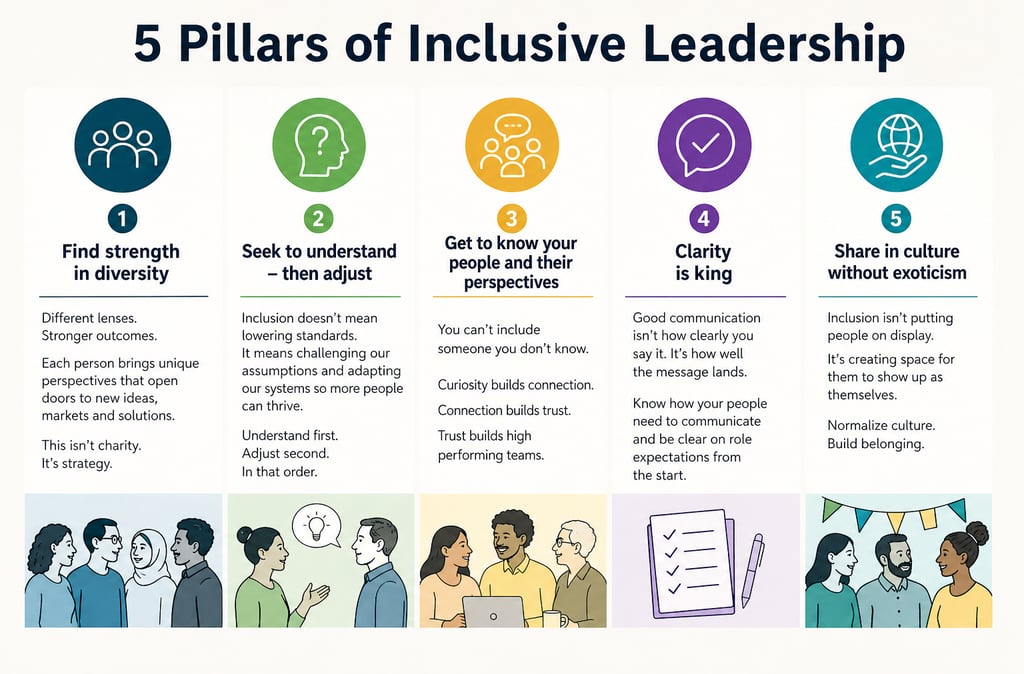
Inclusive leadership is a leadership practice and like all good leadership, it requires intention, curiosity and a willingness to grow. Yes, we need a diversity policy but we don't need a quota, a cultural calendar or another sensitivity training module. What we need are leaders who adjust their leadership to their context.
Here are five pillars I keep coming back to.
1. Find strength in diversity
Every person you lead brings a unique lens. An intern brings fresh eyes unclouded by institutional habit. Cultural diversity brings communication fluency across contexts. Experience brings hard won wisdom. Neurodiversity brings perspectives that most teams would never generate on their own.
Don't think of this as charity. Think of it as strategy.
Each of those lenses is also a doorway into a market, an audience or a problem you couldn't access otherwise. Leaders who can't see that are leaving value on the table.
2. Seek to understand - then adjust
Inclusion doesn't mean lowering standards. It means finding a way to bring in people who don't currently fit your mould, then asking yourself honestly whether your mental model needs updating.
As society evolves, so must our organisations. The leaders who thrive long term aren't the ones who hold their processes sacred. They're the ones who ask: does this system actually work for the people on my team...or just for my idea of a team?
Understand first. Adjust second. In that order.
3. Get to know your people and their perspectives
This one isn't complicated, but it is often underestimated.
Knowing your people is standard leadership practice. It also happens to be the foundation of every inclusion strategy worth its name. You can't include someone you don't know. You can't lead well from assumptions. Spend time learning about their perspectives, the way they see the world will broaden your own worldview, making you a better leader.
Everyone is different. That's life, make the most of these learning opportunities.
4. Clarity is king
Good communication is, so often, misunderstood. It isn't measured by how clearly you deliver a message. It's measured by how well the message lands.
As you get to know your people, get to know how to check in with each of them.
Does this person need written follow-up?
A conversation?
Time to process?
Rather than creating policies like mandating neurodivergent staff quotas, start with something more practical: be crystal clear about role expectations when hiring. Clarity isn't just kind, it's inclusive.
5. Share in culture without exoticism
No one wants to be celebrated for simply being who they are. Turning someone into a spectacle is not inclusion; it's actually alienation.
Try normalising culture instead. Don't schedule a cultural event as a calendar item but don't be a barrier to it being shared either. Remember, too, that culture is far broader than race and religion. Open your eyes to what is important to your team and share in yourself as well.
There's a meaningful difference between tokenism and belonging. The first puts people on display. The second makes room for them to show up as themselves.
Inclusive leadership isn't a destination. It's a practice built one conversation, one decision, one genuine act of curiosity at a time.
What would you add? I'd love to hear where your own practice is evolving.
Lead on. Lead well.
Roland
Keen to connect?
Email me at roland@rolandlewiscoaching.com
Join me for more insights on LinkedIn: Roland Lewis | LinkedIn
Contact
Phone
© 2025. All rights reserved.